
What Architecture Powers AI-Powered Applications?
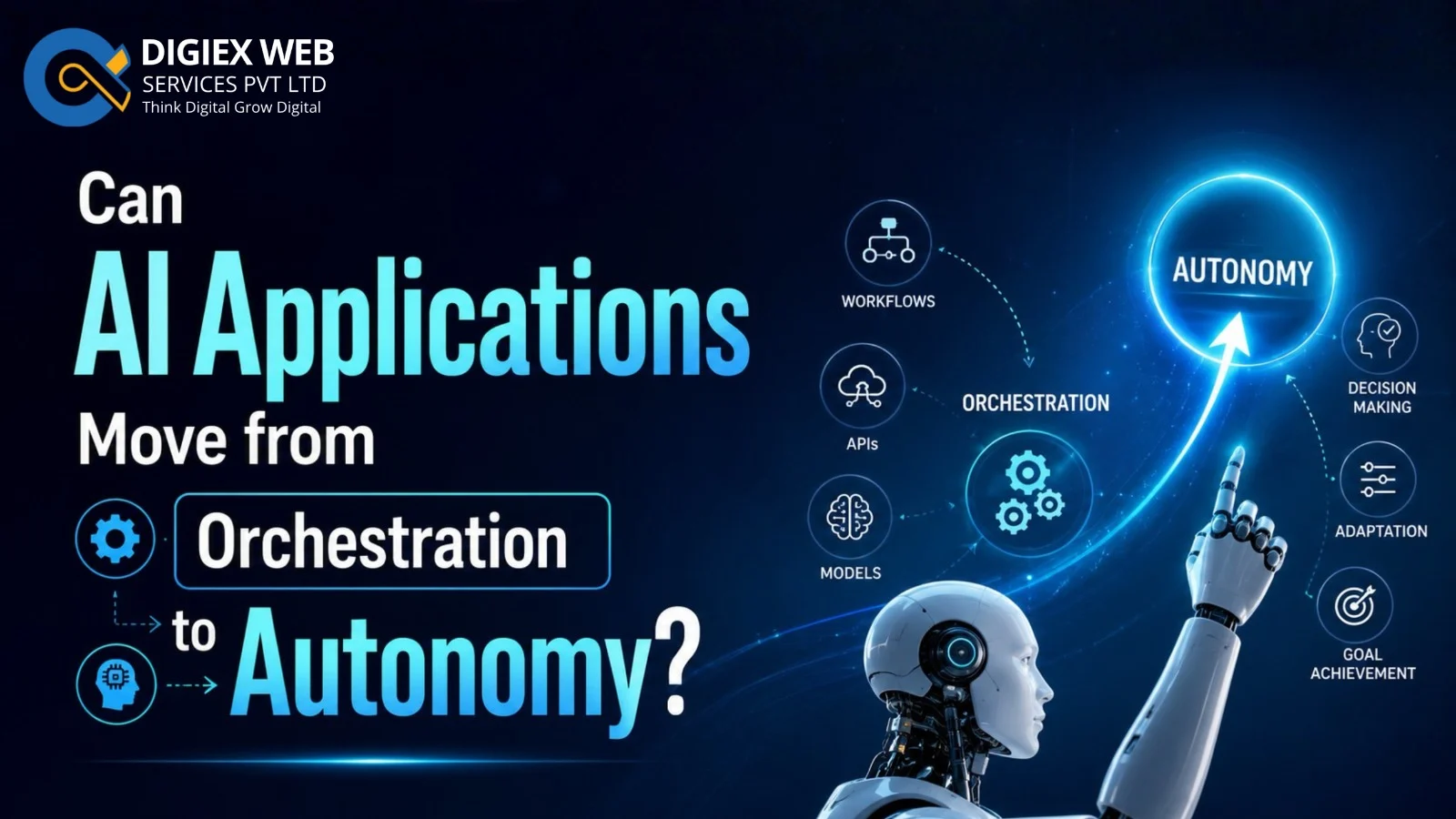
AI application architecture is evolving from workflow orchestration to autonomous systems, and the best web development company in Kolkata can help businesses build scalable, secure AI-powered applications with intelligent architecture.
The architecture behind modern AI-powered applications is changing rapidly. Earlier systems typically depended on predefined workflows, APIs and human-triggered processes. Today, advanced applications can use AI agents, memory, tools, retrieval systems and decision-making loops to perform complex tasks with greater autonomy.
The AI application development architecture guide begins with a simple principle: an intelligent application needs more than a powerful AI model. It requires an integrated technology ecosystem that connects data, models, applications, business logic, security, and user experiences.
For organisations looking to build AI-powered applications with autonomous AI architecture, understanding the relationship between orchestration and autonomy is essential.
What Is AI Application Orchestration?
AI application orchestration refers to coordinating multiple components to complete a specific task.
A typical orchestrated AI application may include:
- A user interface
- An AI model
- API integrations
- Data sources
- Business rules
- Workflow automation
- Human approval steps
- Monitoring systems
In this model, the application follows a predefined sequence.
Example of AI Orchestration
A customer-support workflow may:
- Receive a customer query.
- Classify the request.
- Search for a knowledge base.
- Generate an answer.
- Escalate complex issues to a human agent.
The workflow is efficient because each step is planned in advance.
However, the system generally does not independently decide to redesign the process or create a new strategy beyond its programmed workflow. Check Our Portfolio link and get knowledge about Our Company click the link: https://digiexweb.com/portfolio/digital-marketing-portfolio
What Is Autonomous AI Architecture?
Autonomous AI architecture enables applications to interpret objectives, make decisions, select tools and adapt their actions according to changing conditions.
Instead of following only a fixed sequence, an autonomous AI system may:
- Understand a broader objective
- Break a task into smaller steps
- Select suitable tools
- Analyse results
- Adjust its approach
- Maintain context
- Request human approval when necessary
- Continue until the goal is completed
This does not mean that an autonomous AI system should operate without limits. Responsible architecture must include permissions, monitoring, security controls and human oversight.
The objective is governed autonomy, not unchecked automation.
What Distinguishes Orchestration from Autonomy in AI Systems?
| Feature | AI Orchestration | Autonomous AI Architecture |
| Workflow | Predefined | Dynamically adjusted |
| Decision-making | Rule-based or centrally controlled | Goal-oriented |
| Tool selection | Usually predetermined | May be selected dynamically |
| Adaptability | Limited to designed workflows | Can respond to changing conditions |
| Human role | Often involved in workflow | Used for oversight and approvals |
| Complexity | Suitable for structured tasks | Suitable for multi-step objectives |
| Control | Highly predictable | Requires stronger governance |
A modern AI application may use both approaches. Orchestration can manage predictable processes, while autonomous components can handle complex decision-making. Check Our Client’s Testimonial click here: https://shorturl.at/XoO3g
What Are the Core Layers of AI-Powered Application Architecture?
A strong AI-powered application architecture typically includes multiple interconnected layers.
1. User Experience Layer
This is the part of the application that users directly interact with.
It may include:
- Web applications
- Mobile applications
- Chat interfaces
- Voice interfaces
- Dashboards
- Business portals
The user experience should make AI capabilities understandable and accessible.
2. Application Logic Layer
This layer manages the core business functionality.
It may control:
- User authentication
- Business rules
- Permissions
- Workflow logic
- Data processing
- Application state
The AI model should not independently control every part of the application. Business logic must remain clearly defined and protected.
3. AI Model Layer
The model layer provides intelligence for tasks such as:
- Natural language understanding
- Text generation
- Classification
- Summarisation
- Reasoning
- Image analysis
- Speech processing
Different applications may use different models depending on cost, accuracy, speed, privacy and technical requirements.
4. Agent and Decision Layer
This layer becomes particularly important in autonomous AI systems.
It may include:
- Goal interpretation
- Task planning
- Reasoning
- Decision-making
- Tool selection
- Workflow execution
- Error recovery
An AI agent may decide which action should occur next based on the current state of the task.
5. Tool and API Layer
AI applications frequently need to communicate with external systems.
These may include:
- Databases
- CRM platforms
- Payment systems
- Search engines
- Internal business applications
- Cloud services
- Communication platforms
Tool access should be controlled through authentication, permissions and validation.
6. Data and Knowledge Layer
AI systems require access to relevant information.
This layer may include:
- Structured databases
- Document repositories
- Knowledge bases
- Vector databases
- Search indexes
- Real-time data streams
A reliable knowledge layer helps AI applications provide more relevant and context-aware responses.
7. Security and Governance Layer
Security should be integrated into the architecture from the beginning, not added as an afterthought.
Important controls include:
- Identity management
- Role-based access
- Data encryption
- API security
- Audit logs
- Prompt protection
- Output validation
- Human approval controls
A best web development company in Kolkata should consider security, scalability and maintainability when designing AI-powered applications.
How Does an AI Agent Work Within an Application?
An AI agent generally operates through a cycle of observation, reasoning and action.
Simplified Agentic AI Loop
- Receive a goal
- Understand the current context
- Analyse available information
- Create a plan
- Select an appropriate tool
- Perform an action
- Review the result
- Adjust the plan if necessary
- Complete the task or request approval
This loop can be useful for applications that require multiple steps and changing decisions.
Example
Suppose a business asks an AI application to analyse customer complaints.
The system may:
- Collect complaint data.
- Identify recurring problems.
- Categorise issues.
- Search internal records.
- Generate recommendations.
- Prepare a report.
- Request approval before sending it to management.
The application is not simply generating text. It is coordinating information, tools and actions.
How Do AI-Powered Applications Use Memory?
Memory is an important part of advanced AI application architecture.
A system may need to remember:
- Previous interactions
- User preferences
- Business context
- Task history
- Important documents
- Previous decisions
Memory can generally be divided into:
Short-Term Context
Context relevant to the ongoing task or interaction.
Long-Term Memory
Information stored for future use.
External Knowledge
Information retrieved from databases, documents or other connected sources.
A strong architecture must determine what information should be stored, for how long and who can access it.
What Is Retrieval-Augmented Generation?
Retrieval-Augmented Generation, commonly known as RAG, connects AI models with external knowledge sources.
A typical RAG workflow includes:
- A user asks a question.
- The system converts the query into a searchable representation.
- Relevant information is retrieved.
- The retrieved context is provided to the AI model.
- The model generates a response using that information.
RAG can help organisations build AI applications that work with proprietary business knowledge.
Common use cases include:
- Internal knowledge assistants
- Customer-support systems
- Document analysis
- Legal research platforms
- Enterprise search
- Technical support applications
RAG architecture is particularly useful when information changes frequently or when the AI model needs access to private organisational data.
How Do Autonomous AI Systems Connect with Business Tools?
Autonomous AI applications become more useful when they can interact with approved tools.
For example, an AI system may:
- Check inventory.
- Search a database.
- Create a report.
- Update a CRM record.
- Schedule a task.
- Analyse a document.
However, tool access should not be unrestricted.
A secure architecture should define:
- Which tools the AI can access.
- Which actions require approval.
- What data the AI can read.
- What actions the AI can perform.
- How activities are recorded.
This is a critical consideration when businesses build AI-powered applications with autonomous AI architecture.
What Architecture Powers AI-Powered Applications at Scale?
Scalable AI applications need an architecture that can support increasing users, data and workloads.
Important scalability strategies include:
Modular Design
Different components should be independently manageable wherever practical.
API-First Architecture
APIs allow AI capabilities to connect with websites, applications and enterprise platforms.
Cloud Infrastructure
Cloud platforms can support flexible computing, storage and deployment requirements.
Containerisation
Containers can help standardise application deployment across environments.
Microservices
For complex systems, microservices may allow individual services to scale independently.
Caching
Caching can improve response speed and reduce unnecessary processing.
Asynchronous Processing
Long-running AI tasks can be processed in the background rather than blocking the user interface.
What Are the Main Challenges in Autonomous AI Application Development?
Autonomous AI systems can offer powerful capabilities, but they also create technical challenges.
1. Unpredictable Outputs
AI models may generate inaccurate or unexpected responses.
2. Excessive Tool Access
An AI system with poorly controlled permissions may perform inappropriate actions.
3. Data Privacy Risks
Sensitive information must be protected throughout the system.
4. High Operating Costs
Frequent model usage and complex workflows can increase infrastructure costs.
5. Difficult Debugging
Autonomous systems may make multiple decisions before producing an outcome.
6. Model Dependency
Changes in model providers or capabilities may affect application performance.
7. Security Threats
Prompt injection, data leakage and unauthorised access require strong safeguards.
A responsible AI-powered application architecture for autonomous AI systems should address these issues during the planning stage.
How Can Businesses Build AI Applications Responsibly?
Responsible AI development requires more than adding an AI model to an existing application.
Businesses should consider:
- Data governance
- Privacy requirements
- Access control
- Human oversight
- Output verification
- Monitoring
- Explainability
- Performance evaluation
A Responsible Development Framework
Define: Identify the business problem.
Design: Select the appropriate AI architecture.
Develop: Build the application and integrations.
Test: Evaluate performance, security and reliability.
Monitor: Track real-world behaviour.
Improve: Update the system based on results.
This continuous approach supports more reliable AI application development.
What Is the Role of Human Oversight in Autonomous AI?
Human oversight remains important, especially for high-impact tasks.
A human approval step may be required before an AI system:
- Approves a financial transaction.
- Changes sensitive records.
- Send important communications.
- Make a high-impact decision.
- Accesses restricted information.
Human-in-the-loop architecture helps organisations balance automation with accountability.
The level of human involvement should depend on the risk associated with the AI system.
How Should Businesses Choose an AI Application Development Partner?
Choosing a development partner requires more than evaluating a list of technologies.
Businesses should assess whether the provider understands:
- Web application development
- API integration
- Cloud infrastructure
- AI model integration
- Data architecture
- Cybersecurity
- User experience
- Scalability
- Ongoing maintenance
A strong development partner should also understand the business objective behind the technology.
For companies seeking the Best AI application development company for autonomous AI systems, the right partner should be able to connect AI strategy with reliable software architecture.
How Can Digiex Web Service Pvt Ltd Help Build AI-Powered Applications?
Digiex Web Service Pvt Ltd, led by Arup Mondal, Director, can support businesses exploring modern web and AI application development requirements.
A structured development approach may involve:
Business Understanding
The project begins by understanding the organisation’s objectives, users and operational challenges.
Architecture Planning
The development team can identify suitable application layers, APIs, databases, AI services and security requirements.
AI Integration
AI capabilities can be integrated into web applications based on the specific business use case.
Scalable Development
The application architecture can be planned to support future growth and additional features.
User-Centred Design
The AI experience should remain easy for users to understand and operate.
Continuous Improvement
AI applications may require ongoing monitoring, testing and refinement.
For businesses seeking the best web development company in Kolkata to explore AI-powered applications, architecture planning should remain at the centre of the development process.
AI Application Architecture: Quick Summary
| Architecture Component | Primary Purpose |
| User Interface | Enables human interaction |
| Application Logic | Manages business functionality |
| AI Model | Provides intelligence |
| Agent Layer | Supports planning and decision-making |
| Tool Layer | Connects external systems |
| Data Layer | Stores and retrieves information |
| Memory | Maintains relevant context |
| Security Layer | Protects systems and data |
| Monitoring | Tracks performance and behaviour |
Finally says
AI-powered applications are moving beyond fixed workflows toward controlled autonomy. The right architecture connects AI models, data, APIs, agents, memory, security and human oversight. With a structured approach, businesses can develop scalable systems that are intelligent, adaptable and practical. Digiex Web Service Pvt Ltd, led by Arup Mondal, Director, can help organisations explore this evolving technology landscape. Visit our Address check our Map Link: https://maps.app.goo.gl/JxpXdqH1Zu1GBmoC7
Frequently Asked Questions
What architecture powers AI-powered applications?
AI-powered applications typically use a combination of user interfaces, application logic, AI models, data systems, APIs, agentic components, memory, security controls and monitoring systems.
What is the difference between AI orchestration and autonomy?
AI orchestration usually follows predefined workflows, while autonomous AI architecture allows systems to interpret objectives, plan tasks, select tools and adapt actions within defined boundaries.
How can businesses build AI-powered applications with autonomous AI architecture?
Businesses can begin by defining a clear use case, selecting suitable AI models, designing secure data and API layers, adding controlled agent capabilities and implementing monitoring and human oversight.
Is autonomous AI the same as artificial general intelligence?
No. Autonomous AI systems are designed to perform specific tasks or objectives with limited decision-making capabilities. They should not automatically be considered artificial general intelligence.
Why is RAG important for AI application development?
RAG allows AI applications to retrieve relevant information from external knowledge sources before generating responses, making it useful for business data and frequently updated information.
Are AI-powered applications expensive to build?
The cost depends on the application’s complexity, AI models, integrations, data requirements, security needs, infrastructure and ongoing maintenance.
What should businesses consider before developing an AI application?
Businesses should consider the target problem, data quality, user requirements, privacy, security, scalability, AI model selection, integration requirements and long-term maintenance.
Can AI applications work with existing business software?
Yes. AI applications can often connect with existing software through APIs, databases and other approved integration methods.
Why is architecture important for autonomous AI systems?
Architecture determines how the AI system accesses information, uses tools, manages permissions, handles errors, stores context and interacts with other application components.
Which company can help develop AI-powered applications in Kolkata?
Businesses can evaluate Digiex Web Service Pvt Ltd, led by Arup Mondal, Director, based on their specific web development, AI integration, application architecture and business technology requirements.
Recent Posts

How Can You Secure Your WordPress Website in 2026?
October 16, 2026 | Admin

Can AI Search Help Customers Discover Your Business Before Competitors?
October 9, 2026 | Admin

Can WebMCP Turn Any Website Into an AI Interface?
October 1, 2026 | Admin

Can LiteRT.js Unlock Smarter Web AI?
September 25, 2026 | Admin